
Garage, basement, patio and shop floors
Epoxy Flooring in Greensboro, NC
Ground, tested and sealed concrete built for muggy Piedmont summers and salty winter slush.
- Free on-site estimates across Guilford County
- Moisture readings on the slab before we coat it
- Written quote that lists every prep step and coat
Concrete Coatings Planned for Piedmont Weather
Epoxy flooring in Greensboro, NC has to cope with weather that pulls in two directions. The city sits in the rolling hills of the North Carolina Piedmont at roughly 900 feet above sea level. Summers are hot and sticky, the thermometer falls to freezing or lower on about 75 nights in a typical year, and close to 44 inches of precipitation falls across the year. Epoxy Flooring Greensboro coats garage floors, basements, porches, patios, workshops and commercial slabs across Greensboro and Guilford County, and we plan every floor around that mix of humidity, heat and winter cold instead of reaching for one kit that fits nobody.
What an epoxy floor coating actually does
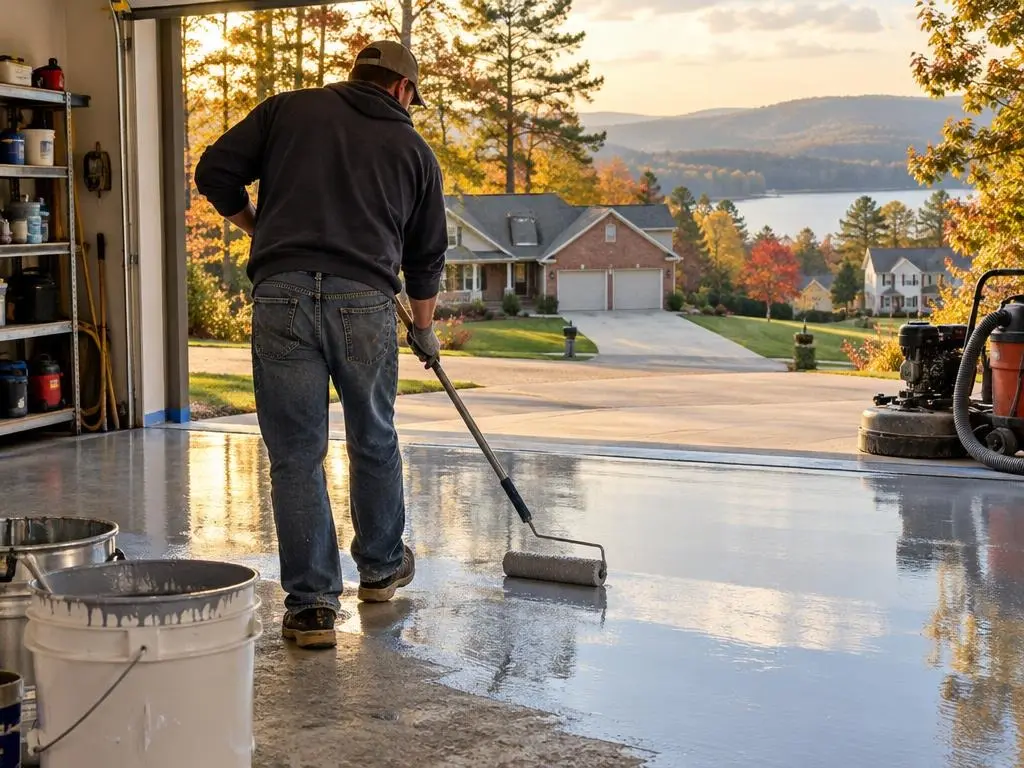
Bare concrete behaves like a hard sponge. It drinks in motor oil, brake fluid, road brine, fertilizer and spilled paint, and its surface keeps shedding fine dust however many times the broom comes out. An epoxy floor coating bonds to a properly ground surface and cures into a hard, sealed layer. Spills sit on top where you can wipe them up. Grit sweeps away instead of grinding in. A coated garage also looks brighter, because the glossy surface bounces around the light you already have. The same idea works on basement floors, shop slabs, porches and commercial floors, with the resin system matched to each one.
Piedmont weather and your slab
Greensboro's climate is classed as humid subtropical with four distinct seasons. July averages close to 79 degrees, and relative humidity averages around 69 percent over the year. That moist air matters on install day: resin applied to a slab sitting near the dew point can cloud, blush or lose its grip, so we read air temperature, slab temperature and humidity before mixing anything. Winter brings a different problem. Cold-air damming often sets up freezing rain here, which can cause more trouble than snow. Cars roll home covered in brine and slush that melts on the garage floor, and a sealed surface keeps that salty water from soaking into the concrete through repeated freeze and thaw cycles.
Systems we install
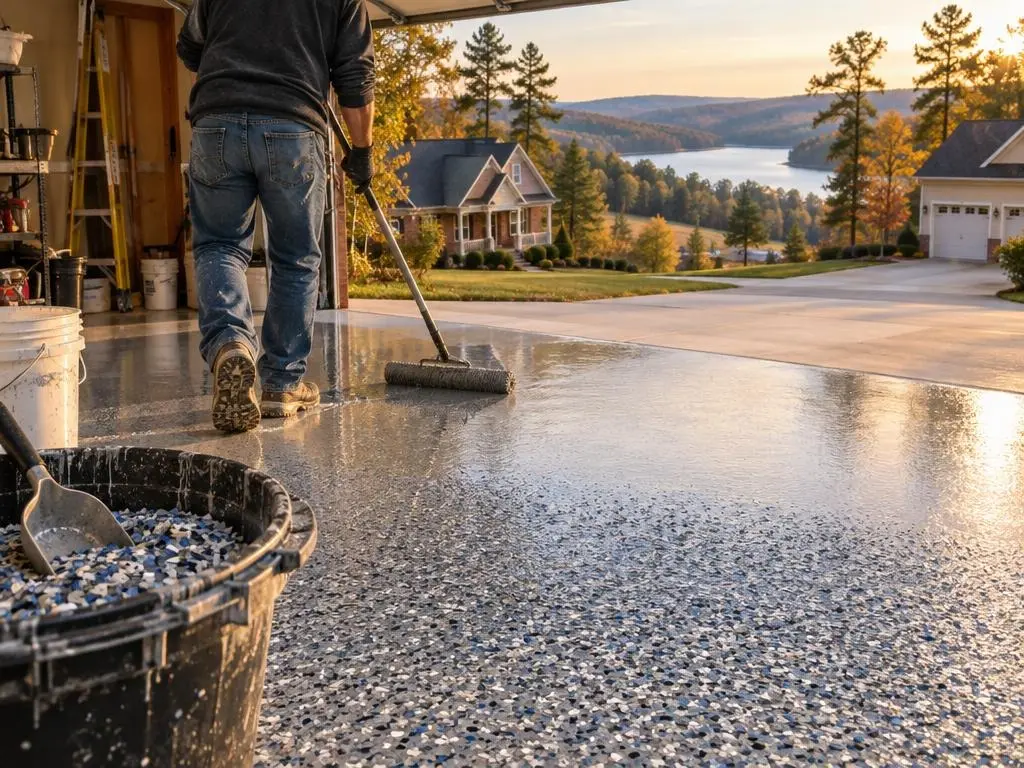
Most Guilford County homes end up with one of a handful of systems. A full flake floor uses an epoxy or polyaspartic base with vinyl chips spread until the base is covered, then a clear topcoat. It hides dust, adds a little texture underfoot and suits busy garages. A polyaspartic system cures faster and holds up far better in sunlight, which helps floors near an open door or outside. For basements, bars and finished shops, metallic epoxy lays down a flowing, marbled finish. Commercial and industrial floors get thicker, higher-solids coatings sized for carts, forklifts and chemicals. Porches and patios get coatings built for UV, rain and freezing nights. Each one has its own page below.
Epoxy flooring cost in Greensboro
Price is usually the first question, and there is no honest single number. According to HomeGuide's national cost guide, a professionally installed epoxy floor runs $4 to $10 per square foot (roughly $1,600 to $5,800 when the space is a two-car garage), while polyaspartic comes in at $5 to $12 per square foot. Patching cracks and chips adds $25 to $250, per This Old House. What moves a Greensboro quote within those ranges is the slab itself: an old painted or sealed floor that must be ground off, wide cracks, flaking concrete by the door, moisture coming through a basement slab, and the finish you pick. We measure and test before we price, and the written estimate we give you is the price for the work it describes.
What to ask epoxy flooring contractors
When you compare epoxy flooring companies or epoxy floor installers around the Triad, a few questions tell you more than any sample board:
- How will you prepare the concrete? Diamond grinding opens the surface; a quick acid wash often does not.
- Do you check the concrete for moisture before coating, and what is the plan if the readings come back high?
- What is each coat made of, and how thick is it?
- Is the topcoat UV stable, or will it yellow where sunlight reaches it?
- How soon can people walk on it, and how soon can a car go back in?
- What is in the written quote, and what would cost extra?
We answer every one of these in writing before any work starts.
Built for the way Greensboro uses its floors
Greensboro is the largest city in the Piedmont Triad, and its floors do many different jobs. Plenty of garages here double as workshops, home gyms, storage for mowers and leaf blowers, and a place to keep the car out of the summer sun. The region's working floors are just as varied. The city grew on textiles, tobacco and furniture, and today manufacturing, logistics and aviation employers around Piedmont Triad International Airport keep warehouse and shop floors busy. A coating that works in a quiet spare room will not last under a jack stand or a pallet jack, so we match the system to the load, the chemicals and the traffic on that floor.
How a typical install goes
Most home floors take one to three days. The first day is prep: we protect walls and doors, diamond grind the slab, vacuum the dust, repair cracks and chips, and prime. Base coats, flake or color, and topcoats follow on a schedule set by the product and the weather. HomeGuide notes that a polyaspartic floor is usually ready for cars within about 24 to 48 hours, while standard epoxy may need several days before you drive on it. We give you the walk-on and park-on times for your exact system ahead of time, so moving the cars and the chest freezer back in can be planned around them.
Caring for a coated floor
A coated floor is low effort, not no effort. Sweep or dust mop grit regularly, because sand under tires slowly dulls any topcoat. Rinse winter salt away before it dries into a crust. Clean with a mild, pH-neutral cleaner rather than harsh solvents. Set a pad or a square of plywood under kickstands, jack stands and heavy equipment feet. Wipe up battery acid, brake fluid and pool chemicals soon after they spill. With that kind of care, HomeGuide puts the life of a solid epoxy floor at 10 to 20 years.
Why Homeowners Call Epoxy Flooring Greensboro
Moisture tested before we quote
We test the slab for moisture vapor during the estimate, because vapor pushing up through concrete is a common cause of bubbles and peeling in humid climates.
Diamond-ground prep, edge to edge
We grind every floor, right up to the walls and into the corners, so the resin grips sound concrete rather than old sealer or soaked-in oil.
Installs timed to the weather
We check slab temperature, air temperature and humidity before mixing resin and move the date if a muggy morning or a cold snap would hurt the finish.
One written price
Your quote spells out the system, the coats, the repairs and the cure times. The number on it is what you pay for that scope.
Common Questions
What should I budget for an epoxy floor?
Using national figures from HomeGuide, an installed epoxy floor costs $4 to $10 per square foot. In garage terms that is about $1,200 to $3,900 for a one-car garage and $1,600 to $5,800 when two cars fit. Polyaspartic is priced higher, roughly $5 to $12 per square foot. A Greensboro floor moves toward the high end when it needs an old coating removed, cracks repaired, a moisture primer or a decorative finish, which is why we only price after we have seen it.
What are the drawbacks of an epoxy floor?
Standard epoxy does not handle sunlight well; HomeGuide scores its UV resistance as only poor to fair, which means it may turn yellow by an open door or outside. It also needs days of cure before you park on it, it can be slick when wet without a grit additive, and it fails when it goes over moisture or poorly prepared concrete. We deal with these by grinding, testing for moisture, adding texture and using UV-stable topcoats where the sun hits.
How do you tell whether my concrete is too damp to coat?
We test it. During the free on-site estimate we take moisture readings on the slab, at several points on a large floor and wherever it meets the soil at the back wall. If vapor is coming up, the plan includes a primer made for damp concrete. If the readings are too high for any coating to hold, we tell you that instead of selling you a floor.
Which floor is best for industrial use?
For most industrial floors the answer is a thick, high-solids epoxy or a urethane-type system put down over diamond-ground or shot-blasted concrete. For 100 percent solids coatings in commercial and industrial spaces, HomeAdvisor's figure is $12 a square foot and up. Which build fits comes down to the loads, the chemicals that land on the floor, hot water washdowns and how much downtime the operation can accept.
Is a Greensboro winter too cold for coating a garage floor?
Usually not, though some winter days are. Resin needs the slab and the air within its listed temperature range, and the slab needs to stay above the dew point while it cures. On a cold stretch we may heat the space, choose a product rated for lower temperatures, or move the date. A slab that sits below the product's range, or is still wet from melted slush, does not get coated.
Should I choose epoxy or polyaspartic for my garage?
Polyaspartic cures much faster and resists UV far better, which suits garages that sit open for long stretches. Epoxy builds thicker coats for a lower material cost and makes a strong base. A lot of the floors we install combine them: epoxy underneath for thickness and adhesion, with polyaspartic on top to handle sun and wear.
What is the lifespan of an epoxy floor?
HomeGuide gives 10 to 20 years for a solid epoxy floor against only 3 to 5 years for the thin, water-based coatings sold in many store kits. Real life depends on prep, thickness, traffic and care, which is why we spend most of an install on the concrete before any color goes down.
Towns We Cover in Guilford County
We work throughout Greensboro and across Guilford County, including Summerfield, Oak Ridge, Stokesdale, Browns Summit, Jamestown, High Point, Pleasant Garden, Sedalia, Whitsett, Gibsonville and Colfax. A lower-level slab near Lake Brandt, Lake Higgins or Lake Townsend, or along the Haw and Deep rivers, can be a different job from a garage on high ground, and newer subdivisions bring slabs that may still carry a curing compound from construction. We test and plan each floor for where it is.
- Epoxy Flooring in Greensboro, NC
- Epoxy Flooring in High Point, NC
- Epoxy Flooring in Jamestown, NC
- Epoxy Flooring in Summerfield, NC
- Epoxy Flooring in Oak Ridge, NC
- Epoxy Flooring in Stokesdale, NC
- Epoxy Flooring in Pleasant Garden, NC
- Epoxy Flooring in Gibsonville, NC
- Epoxy Flooring in Whitsett, NC
- Epoxy Flooring in McLeansville, NC
- Epoxy Flooring in Burlington, NC
- Epoxy Flooring in Elon, NC
- Epoxy Flooring in Graham, NC
- Epoxy Flooring in Mebane, NC
- Epoxy Flooring in Kernersville, NC
- Epoxy Flooring in Winston-Salem, NC
- Epoxy Flooring in Thomasville, NC
- Epoxy Flooring in Archdale, NC
- Epoxy Flooring in Asheboro, NC
- Epoxy Flooring in Reidsville, NC
- Epoxy Flooring in Liberty, NC
- Epoxy Flooring in Clemmons, NC
Our Epoxy Flooring Services
Six coating systems for Greensboro garages, basements, porches, patios and working floors, each chosen after we test the slab.
Garage Floor Coatings
Epoxy and polyaspartic garage floors ground, repaired and sealed against oil, mud and winter road brine.
Learn more →Flake Epoxy Flooring
Vinyl chip floors that hide dust and tire marks, add texture underfoot and come in dozens of blends.
Learn more →Polyaspartic Floor Coatings
Quick-curing coatings that stand up to UV, so you park sooner and the color stays true near open doors and outside.
Learn more →Metallic Epoxy
Poured, marbled epoxy that adds depth and flow to basements, bars, studios and showcase rooms.
Learn more →Commercial & Industrial Epoxy
High-build epoxy and concrete floor coatings for shops, warehouses, kitchens, clinics and manufacturing floors.
Learn more →Porch & Patio Coatings
UV-stable coatings for porches, patios, walkways and pool decks that handle sun, rain and freezing nights.
Learn more →Get a Free Greensboro Floor Estimate
We come out, check the concrete for moisture and put the price in writing. Call (336) 962-4282 or send the form.